Friday, August 7, 2015

August 7, 2015

Lessons learned this year from the new set up using the higher raised beds and drip irrigation. When I first set a schedule I just followed the schedule used by the landscape folks on the yard - 3 days at 20 minutes per station as I had no idea how to start (we had to modify that considerably once the plants had a few months to get somewhat established and once we realized how much water that used - quite a bit!). 
Having been through the growing season just over a half year now, I know now that we simply hadn't been giving the raised beds enough water overall. The old beds were only a foot above the ground level which allowed the plants with deeper roots, i.e. the tomatoes, squashes, etc., the opportunity to reach the indigenous rich, clay soil in the ground. Now that the beds are much higher off the ground, I need to supplement the soil in the beds, a sandy loam we truck in, with more nutrients and more water than what 20 minutes of drip supplies.
I've started supplementing the smaller plants like lettuce, peppers, herbs, carrots, beans, etc. with some hand watering during the week as needed and they've been responding quite well. As for the tomatoes, I've pretty much given up trying to save them as we still need to get our landscape plants established, it's too late in the year and we simply can't use more water than we already use due to the horrific drought. Hopefully we'll have at least a normal rainfall this winter. All indications (92% probability) are that a strong El Niño is coming so hopefully we'll get some relief for next year. If so, then the drought-tolerant landscape should have established once next year's growing season comes around. My plan then is to go back to the hand-watering I used to use to get an idea of how wet I need the soil to be. Once I have a good idea from that, then I'll start up the drip to emulate the conditions I've set. I'm thinking it will be considerably more than what it was this year. Since the yard will need much less water we should be able to accommodate the raised beds with more water. God help us if we have another dry or drier winter. We're already seeing significant stress on the trees around here and it's not clear how many of them will be able to survive these conditions much longer.

Given all of this, we're starting to see some nice yields finally. Evening temperatures have been pretty high over the past several weeks (lows ~62F°)with some normally warm days as well (70's).

Dirty Girl tomatoes - Romano beans

First garlic harvested

Box 1


The only garlic I could find last year was California Late White. Now I know why it's called 'late'. Although the tops have pretty much died back, the stalks are still quite green inside and the cloves have yet to completely form. The photo above shows a stalk I pulled a couple of weeks ago. When I cut the bulb off, the stalk was still green; most of the cloves set in the bulb but not all. I plan to pull some more over the next few days to see how they've progressed. 
The arugula took over the other side of the bed shading the mesclun and lettuce thereby preventing them from growing much. The beets on the end are growing but the greens have quite a bit of mildew.

Box 2


We're in the height of summer; the beans are finally starting to produce and the squash is looking a lot healthier now. The extra hand-watering seems to be paying off.

Box 3


Ah well, hopefully I'll have better luck with tomatoes next year. The Purple Cherokee at the southeast corner of the bed seems to have developed a nasty fungus with the inner stalks starting to starve out. Since this bed won't be used for tomatoes again until 2019, the fungus should die off by then.


Box 4


The herbs are responding well to the extra hand-watering, the parsley especially but even the oreganos, dill, and cilantro.

Box 5


The peppers, especially the padróns, are finally kicking in. The seeded Jimmy Nardellos never developed but they may still have a chance with some extra TLC. Basil is fine, carrots are kicking in, the latest seeding of lettuce is coming along nicely. Again it's the extra watering that seems to be helping here.


Containers 


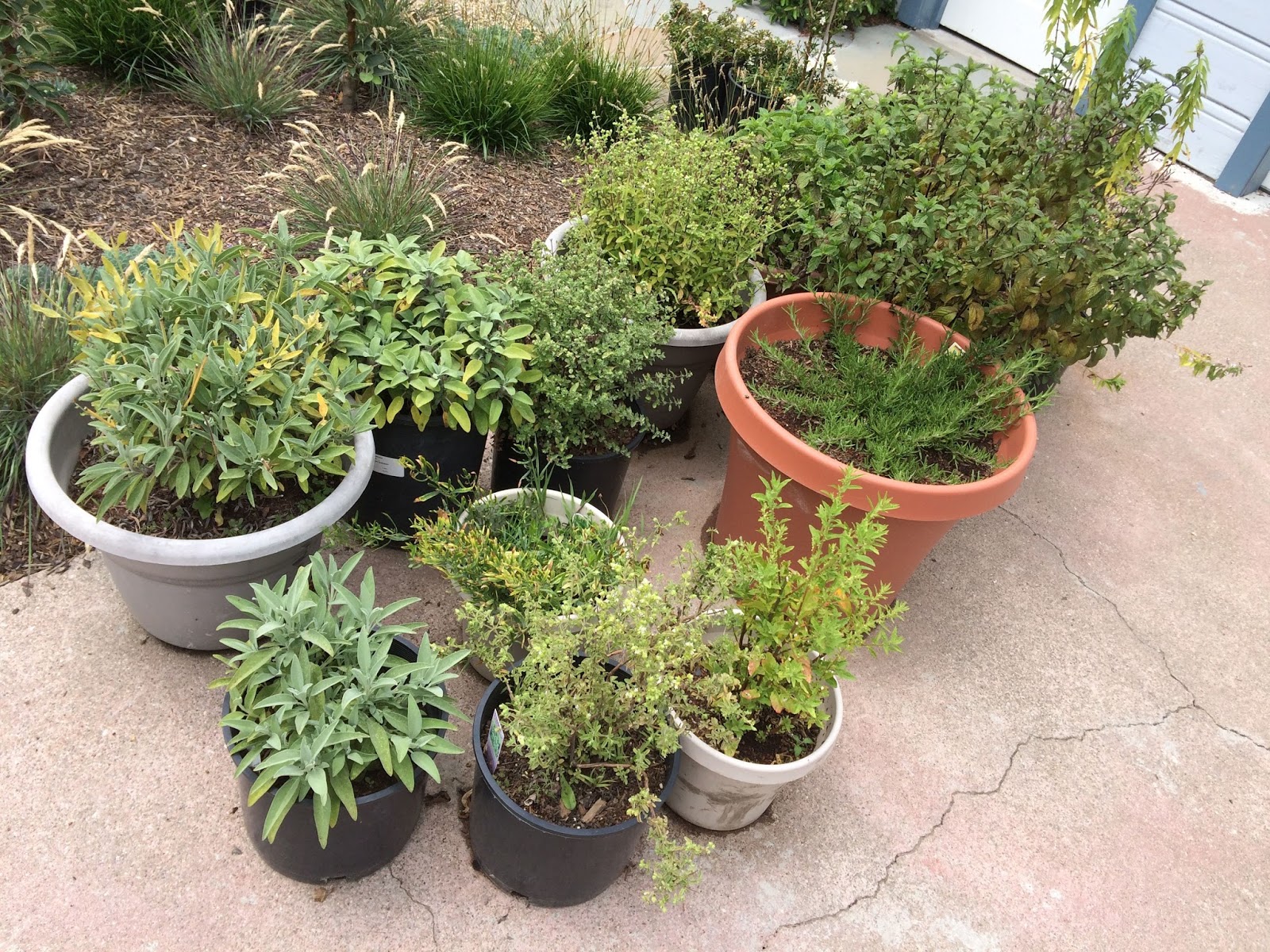
I'm still down to watering only once a week, feeding once a month, and everything's surviving. The mint could use some pruning, the tarragon is fine as are the oreganos and sages.

Friday, July 24, 2015

July 24, 2015

The weather has settled into a normal pattern for July except for warm evenings like the past couple of years and the unending, constant 12-15 MPH winds. The days are about 65-75F°, the early mornings bottoming out at about 62F°, noticeably higher than what used to be normal, about 55F° with significantly more fog.
Now, as opposed to last post, I think the tomato situation is due to under-watering them. I've still much to grasp about drip irrigation, specifically how long and how often a schedule is required to match what I'd always done with hand watering. The depth of the raised beds might have something to do with it. The old beds, being only 1' above the ground soil level, offered easy access to the rich soil indigenous to our area. Although it tends to be quite clayey, it has a lot of nutrition. In the higher beds, the plants only ever have access to the soil I've brought in - a much sandier loam with perhaps less nutrition, I'm not at all sure.

Box 1


I dug up a few garlic bulbs and to my surprise they have yet to develop cloves. Cutting into one of them showed that they are still quite green inside and they have not yet matured though the appearance of the leaves would seem to indicate that they have. I've not grown California late whites before so I guess 'late' would indicate something considerably later than I'd expected. 
The greens are still growing slowly though well.

Box 2


The squash are starting to look better. I'm not sure if they are getting enough water though. I have shrubblers on them, as with the tomatoes, but still figuring out how well that works. I may try hand-watering next year to start things in general, especially if we get anything close to a normal rainfall this coming winter.
The beans are looking not so great either so I've decided to start hand-watering them at least once a week to supplement the drip schedule of 3 times at 20 minutes.

Box 3


The plants are yielding tomatoes but they still look like shit, the yields are significantly less than normal, nothing close to the past couple of monster years. Chalking this year up to a learning curve.

Box 4


I've removed the last old parsley and cultivated the soil around the new ones. The new ones seem to not be growing all that robustly though still alive. The stalks in the center of the marjoram have died back so I pruned that all out. Apparently marjoram has higher water requirements than do oregano plants so more water for them too. The two oreganos look like crap and the thyme is staying at status quo. The one large basil, the sage, and the Mexican oregano, on the other hand, have all been doing well.
Perhaps this box needs more water than I thought also.

Box 5


The padron peppers seem to finally be feeling it. The warmer overnight temperatures have certainly not been unkind to them. The Jimmy peppers from seeds are still stalled. The carrots and basil are coming along nicely. The new greens on the west end of the box are progressing ok.
I removed the last of the beets today as they had grown as much as they were likely to and I thought the extra room for the other rows would be good.

Friday, July 10, 2015

July 10, 2015

The past few weeks have a bit more normal for the area - inland spots have been up in the 80's-100's and high 60's-low 70's around here. Nighttime temperatures are now hovering in the high 50's-low 60's. It's still breezy most days but it seems to have calmed down considerably overall.
Now I think that the tomatoes having done rather poorly is due to overwatering on my part in addition to the cooler temps in May and June. Since this is the first time I've used drip irrigation I had not realized just how wet the settings I had was getting the soil for that bed. The winter crops all depended upon the tubing but I used emitters with shrubler ends to deliver water to the tomato plants and way too much at that. I've backed off from 3 days@20 minutes to 1 day. I still want to deep water them but I guess I need to let the soil more time to dry out. Between the warmer temperatures and the cutback of watering frequency, the plants seems to be reviving. A lesson for next year.


Box 1

The garlic is still a bit green, I guess softneck varieties take longer to die back. Due to the consistency in the watering, I've only come across one bloom. The heads seem to have reached a pretty good size from what I can tell. 
As for the greens, it seems that I hadn't prepared the soil for the seeds well enough. This time I watered it thoroughly before seeding and covered them with bird netting. When I misted before I didn't realize that the water was only going down a very little. When keeping it moist now, I make sure that the water has really penetrated. This works a lot better.

Box 2


I think I may have been overwatering the squash as well. I've cut back on it and am keeping better track of the soil moisture. The beans are using the tubing and are starting to get in gear also after a slow start. I've staggered the seeding over 3 times 3 weeks apart but they all are coming up more or less together anyway.

Box 3


We're getting fruit but as mentioned above, it's not nearly what we've had the past two years. We'll see how it goes.

Box 4


 The tarragon was doing ok but starting to get straggly and somewhat used to its corner. Since I really don't use much and the plant in the container was doing well, I pulled it and moved it into its own pot.
I also potted the second chives all to make room for parsley which I use a lot. I also seeded more cilantro and dill which is already starting to come up. The oregano really doesn't seem to like this box although the marjoram is doing fine. Maybe also overwatering? I'm keeping an eye on them, maybe it just takes a while for it to adapt.

Box 5


I pulled the remaining chard and kale and seeded lettuce, mesclun, and radishes. The peppers seem to have really felt the cool temps this spring and the summer is nowhere near as warm as the past two were so back to normal for them. Maybe they will rebound if the summer and autumn warm up. The basil and carrots are doing fine though seem to be moving slower than I would have expected them to.


Citrus


The lime, although still alive, really is not looking well at all. Maybe it takes some time for it to adapt to the space. The lemon is thriving with a lot of fruit and the mandarin seems to be doing well. I really hope we get some decent rain this coming winter.


Containers